 From the makers of ...
'MAESTOSO': A LOOK-BACK FORTY YEARS ON
By one of the 12,000
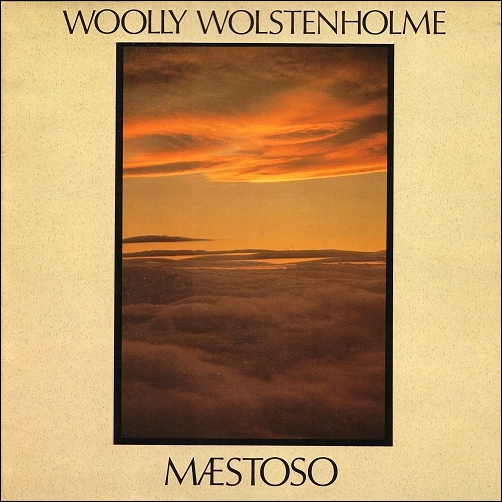
'Maestoso', the first of five albums that Woolly Wolstenholme released outside of Barclay James Harvest, appeared in the shops in October 1980; the precise date of release is not known. I have a vivid memory of buying my copy: a special trip to W.H. Smith, a beeline to the 'W' rack & there it was, available for me to take home if I forked out £6.49. I was staggered by the price - this was a time when it was possible to buy an album for about four quid. But it was Woolly and it was October, which meant that I'd just got my hands on my grant cheque, and there was only one copy in the shop - and so, clutching the album tightly in case anyone snatched it out of my hands, I strode across to the till.
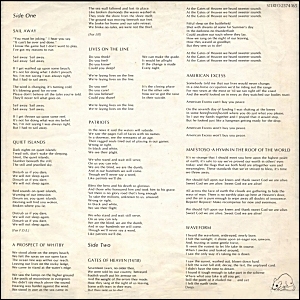
From the first time I played the album, I loved it. Throughout winter 1980-1, I listened to it almost every day. Idly flicking through Melody Maker whilst waiting for a seminar to begin at the University of Birmingham, I came across a very nice review of the album. I cut it out and stuck it on the inner sleeve of the album. Years later I discovered that Woolly had not seen the review. A photocopy was dispatched to Keith and, at last, Woolly was able to read the review. And even more years later I discovered that, as an early purchaser of the album, I had missed out on the lyric sheet. Finally, thanks to the Domone Archive, that has now been slipped into the LP. So I was one of the 12,000 who purchased 'Maestoso' when it came out. To mark its fortieth anniversary I asked Keith if he could put me in touch with the people who made this album with Woolly. He agreed - and this article is based on their memories of how they helped Woolly produce this album of fragile beauty, depth of feeling and, above all, just bloody good songs.
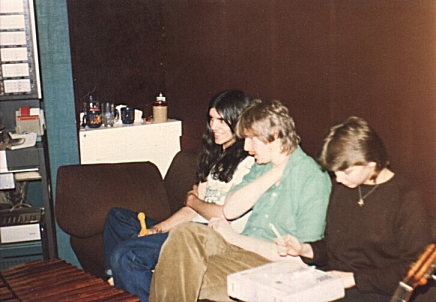
Steve, Woolly and Jill in the control room at Strawberry
We know that three of the songs that appeared on 'Maestoso' were presented to his colleagues in BJH for what became 'Eyes of the Universe.' These songs were: 'Lives on the Line'; 'A Prospect of Whitby'; and 'American Excess'. The first two were earmarked for use by the band. Despite this Woolly was feeling unenthused about working on a new BJH album. Jill Wolstenholme recalls him feeling that they weren't doing justice to 'Lives on the Line':
'I remember that Woolly was very disappointed when the song was being routined by the band that the rhythm section didn't seem able to deal with the 6/8 time signature and he felt the song was losing its edginess. Quite the opposite happened when it was performed live by Maestoso as they always managed to speed up throughout the performance and I always breathed a sigh of relief if they got to the end of it without it ending in chaos and disaster!'
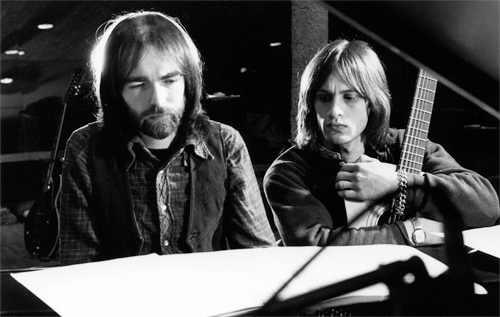 David and Kim at Strawberry
Jill remembers the great efforts Woolly put in when he was working on 'A Prospect of Whitby', which is arguably his best-loved song:
'The bare bones were laid down very quickly, but Woolly became enthralled with trying to paint with sound when he made the demo and put in hours of work. The essence of the song came from a weekend visit we made together to Whitby in November 1977, not long after we were married. We used to call this our 'honeymoon'. The weather was not great, but what do you expect on the north-east coast of England in November? There had been a break in the sea wall. Woolly was always fascinated by the sea. The lyrics used poetic licence as, in them, we are watching the sea wall being breached, although actually we didn't see that happen. In the music you hear a sound picture of the sea rushing through the breach. It is a beautiful song and brings back memories of a very happy time for me.'
The last of the three songs written whilst Woolly was still a member of BJH has an interesting story attached to it. When 'American Excess' was being mixed for 'Maestoso', Woolly discovered that the words "Where's Dave?" could unexpectedly be heard. The band were recording over another song which had been rejected and these words had been uttered by Woolly when he could not see David Rohl, who was producing the album, in the control room; David had nipped out to ring his girlfriend, who was in London. The words seemed to fit so well with the mood of 'American Excess' that they were left.
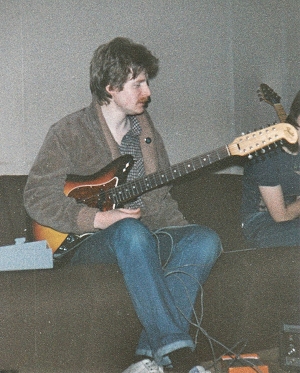 Woolly in the studio with his Fender electric 12-string
With the exception of 'Maestoso - A Hymn in the Roof of the World', which was a left-over from 1974, the other songs which appeared on 'Maestoso' were written, and demos recorded, at Woolly's house in Greenfield after he had severed his links with the band. Jill takes up the story: 'The pianos, Mellotrons and synths were all in the dining room and the L122 Hammond organ in the hall. Good job we were both thin in those days or we would never have been able to leave the house! The demos were recorded on an 8 track tape, with me acting as engineer and Woolly as producer.' Mostly Woolly wrote the music before the lyrics for these songs, but, in some cases, a line or two was there from the beginning. For example, the words of the refrain 'Sail Away' were always attached to the notes - with the rest of the lyrics coming later. Jill was there to offer help with the lyrics if he needed it. 'I was there as a constant soundboard while Woolly was writing', she recalls, 'and saw the songs through from their gestation to their birth, so it was only natural that there were little tweaks here and there with odd words suggested and accepted if they seemed stronger or more pertinent than the originals.' (Jill makes clear, however, that the only whole line in one of Woolly's songs that she can lay claim to came before he left BJH - it is 'A void no man can justify' from 'In Search of England', achieved after 'much trial and error by us both'.)
'Quiet Islands' reflected Woolly and Jill's shared concern for the environment. They were both members of Friends of the Earth, though not very active. This issue continued to matter to them both when they ran their farm organically according to the standards of the Soil Association. In 1994 they won the Loraine Award for Nature Conservation.
During the recording of the album Woolly spent a lot of time experimenting with percussion. One of the shakers that was used was a plastic 35 mm film pot filled with basmati rice! At the end of 'Patriots' bells and a small gong being lowered in and out of water when struck can be heard - as can the very top note on the Solina (a synthesizer), played by Jill.
Woolly and David Rohl had been collaborating for a number of years before work began on 'Maestoso'. They had composed and recorded, at Strawberry Studios in Stockport, the music for several Cosgrove Hall animation films which were shown on ITV, one of them securing two BAFTA awards. David had also acquired experience by working on projects in London for George Martin and Tim Burgess' AIR elite producers' group. His selection as producer for 'Maestoso' flowed seamlessly from an already-established partnership. At this time he was living in Surrey and travelled up to Strawberry each week, staying at a local hotel. The musicians who recorded 'Maestoso' knew each other well and worked together well - and had great support from Strawberry's manager Pete Tattersall. David recalls the role he played as producer:
'My job was to nurture, and sometimes control, the genius of the Maestoso in charge. It just may be me … but I felt Woolly's later albums were a bit too raw and untamed for my tastes. What I brought to the party was sound, organisation, performance, judgement and, hopefully, some inspiration. A producer's job is all those things, plus the creation of a happy and productive environment, while ensuring that the sessions are efficient and not over-indulgent. In Woolly's case, one of the primary goals was to expose the beauty of his fragile voice, which so many BJH fans love. He was not the most accomplished vocalist in BJH, but he had a plaintive quality that reached into the depths of the listener's heart. So, when I say 'performance', I am talking about every aspect … but, most importantly, when it comes to lead vocals, the passion and sensitivity of a man who was both a musical genius and a fragile personality who found life in BJH a struggle in the later years.'
Woolly believed that David had the volume in the control room far too loud and was always asking him to turn it down. The song 'Too Much Too Loud Too Late', written shortly after 'Maestoso' was completed, was inspired by this experience. One day Woolly and Jill got a chinagraph pencil (a wax, wipeable pencil used for writing on the mixing desk) and drew trickles of blood coming out of their ears and running down the sides of their cheeks. They began to groan, and David eventually turned round. 'How long it took him to realise it was a joke', Jill recalled, 'I don't know; probably a fraction of a second, but he certainly did a beautiful double-take.'
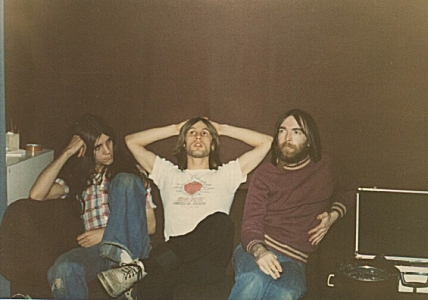
Steve, Kim and David during recording of the album
As breaks from recording, Woolly and Jill would stroll around Stockport. On one such excursion they decided to visit a charity shop, where they bought a selection of hats suitable for older women. Typically Woolly had a plan for their new acquisition: they would be worn by everyone when working in the studio. It was the sort of humour that greatly appealed to drummer and percussionist Kim Turner - he recalls how he would 'exchange … (with Woolly) unusual and banal gifts such as kitsch 1950s place mats and knitted tea cosies.' However, on this occasion, it was a friend of Kim's, who was visiting for the day, who declined to wear one of the newly-acquired hats. Thereafter Woolly and Jill would describe someone who wouldn't join in with something because of a concern that they would look stupid as 'a person who wouldn't wear a hat'!
For Steve Broomhead 'Maestoso' was only the second album where he had been the main guitar player. The first album in that role had been the 'The Eye of Wendor' and he became David Rohl's 'go-to guitar player. I automatically got involved in other things he was doing. It was during the sessions for 'Cockleshell Bay' I think that I must have first met Woolly and Jill. I got on great with them straightaway. They had a daft sense of humour and rarely acted like grown-ups … just like me! Woolly would turn up at Strawberry to play some parts on the Mandalaband album and also other Cosgrove Hall projects such as 'The Talking Parcel', 'Cinderella' and 'The Pied Piper', all of which I played on. So we'd spent a lot of time hanging out and getting to know each other by the time he was ready to do his solo album.'
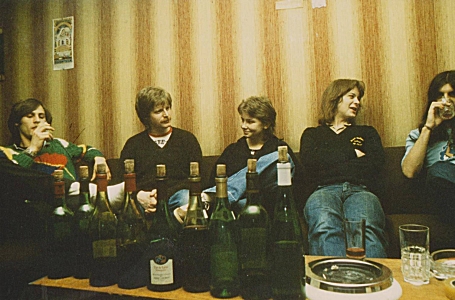
Wine tasting at Strawberry (during the recording), Kim, Woolly, Jill, Chris Nagle and Steve
Kim Turner had also played on the 'Eye of Wendor' and on the Cosgrove Hall projects. The son of a professional musician and later clubland comedian known as Pancho Villa, he had arrived in Manchester from a small village in North Yorkshire at the age of sixteen, already a BJH fan, having seen them with the orchestra at the famous Weeley festival. Recruited by David Rohl to work with him at Indigo Studios and - as related in the pdf file that accompanies this piece - he was soon working on what became the 'Eye of Wendor'. Kim remembers these days with great affection: 'I was initially recruited as the drummer, but ended up being able to contribute much more significantly than I had originally anticipated, playing not only drums on most of the tracks but also multiple percussion (tambourine, congas, timpani etc), tuned percussion (marimba, vibes, glockenspiel, tubular bells), sound effects (prepared piano, water gongs, bells, glasses and various screams, creaks and stomps), guitar and performing backing vocals on many of the tracks too. I look on this experience as my apprenticeship period with gratitude to Dave Rohl who, by the end had started referring to me as his right hand man (even though I'm left-handed!) As a consequence of my involvement I found myself meeting and playing with lots of illustrious musicians who featured on the album, including Woolly and the rest of Barclay James Harvest. Woolly contributed a great deal to the Mandalaband album so consequently we ended up spending quite a lot of time together at Strawberry, including 'down time' shooting the breeze, playing pool and sampling the odd glass of red.'
The working day at Strawberry began for the 'Maestoso' musicians at about 10 am each morning and continued until the evening. There were lengthy breaks over the three months they recorded the album. On the first day they worked on 'Sail Away', which Kim counted in and describes as 'a responsibility that I truly relished.' Steve adds: 'Woolly had pretty complete demos for all the songs and so I didn't have a lot of creative input to that album, but there were moments. The only extra track we recorded was 'All Get Burned.' There was no demo for that so I felt free to add my mark with the skysaw type guitars. I did a similar thing on 'Love is …' years later. My favourite track on the album is probably 'Patriots' … I just like the tune.'
Kim has fond memories of the sessions:
'I am still very proud of the album 'Maestoso' and my contributions to it. The recording sessions lasted only a few weeks but were thoroughly enjoyable and exciting. The 'vibe' in the studio was great and special mention should be given to four unsung members of the team: Woolly's ever present and supportive wife Jill; photographer Roger Heeley Barnes for his general bonhomie; the lovely Trevor Worman in charge of logistics; and to assistant engineer and all round good guy Chris Nagle. We worked at a fairly brisk pace, initially getting a basic 'bed' or two down per day, and then subsequently building up the tracks with overdubs. Though the basic songs were written and Woolly had a clear vision of what he wanted, there was still a modicum of room for individual artistic expression and experimentation with the overdubs. Though I have been a songwriter since taking up guitar at the age of fourteen, I also enjoy co-writing and contributing 'parts' to songs. My favourite tracks on the album are 'A Prospect of Whitby' and 'Lives on the Line', though I am particularly fond and proud of a certain inventive, cross rhythmic and 'in your face' (if I say so myself) hi-hat/bass drum fill in 'Maestoso - A Hymn in the Roof of the World' that I had to fight tooth and nail to keep in - Woolly hated it!'
To sustain them whilst they worked, the musicians tucked into sandwiches, fish and chips and Chinese takeaways, but, once or twice a week, Jill would prepare, in the kitchen at the studio, huge cauldrons of chilli con carne, boeuf bourgignon and spaghetti bolognese 'for my boys'. When the album had been recorded and mixed, friends and supporters were invited into the studio for nibbles and wine and to listen to the tapes.
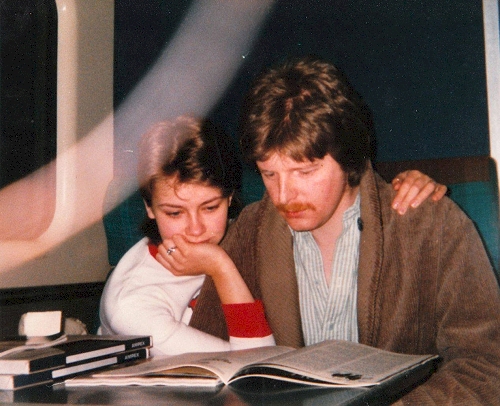
Jill and Woolly taking Maestoso master tapes to London on the train
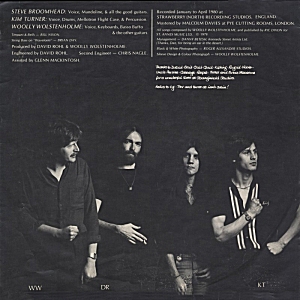
The art work for the album was produced by Woolly and Jill, the photograph on the cover being taken by Woolly. Jill drew the picture of a mouse on the lyric sheet inside the album (a nickname she and Woolly used for each other) and wrote out the credits, again using nicknames. Now, after forty years, the identities of those mysterious individuals can be revealed:
- Dotoid - Jill
- Broid - Steve
- Croid - Chris Nagle (tape op who sometimes sat in for David)
- Gloid - Glen (who worked at Strawberry)
- Kipling - Kim
- Rogoid Noble- Roger Heeley Barnes (who also worked at Strawberry)
- Uncle Pee Wee - Peter Tattersall (studio manager)
- Cabbage - Karen (studio receptionist & office assistant)
- Raspie - Richard Scott (electronics wizard at Strawberry)
- Hazel and Forbes Macaroon - Forbes Cameron & his wife (publicist for the band and remembered by Jill as 'a lovely, warm giant of a man who died far too young')
- Stranglehold Studios - Strawberry Studios
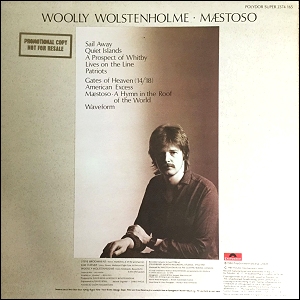
Woolly had wanted to record a solo album whilst still a member of BJH, but, with the band's burgeoning success, that was simply not possible. So he left the band. 'Maestoso' was self-funded, but Woolly managed to secure a record deal with Polydor. Woolly and Kim did a tour of UK radio stations to promote the album on its release, but Woolly felt that Polydor could have done more in support of the album. It might perhaps have been better if Woolly had released his album through a label that was not associated with his old band.
Even before 'Maestoso' had been released, Woolly had written almost all the songs, and recorded demos of them, for a second album. 'We were all quite optimistic at that point', Steve remembers. 'After the 1981 tour we went back into the studio and recorded some more tracks … 'Too Much, Too Loud, Too Late', 'Deceivers All', 'Has to be a Reason'. Playing live had brought us together musically and we now sounded like a band.' The proposed second album, however, had not been approved by Polydor and did not appear. 'The freedom of expression the split with BJH had afforded him was like the bursting of a dam', Jill recalled of Woolly's prolific output at this point, 'through which the water just kept pouring.'
Acknowledgements: I am indebted to Steve Broomhead, David Rohl, Kim Turner and Jill Wolstenholme who so willingly gave up their time and without whom I simply could not have written this piece. Thanks also to Keith Domone who liked immediately the suggestion that I write this fortieth anniversary piece for Woolly's website.
If you would like to read more about Kim Turner's story as a musician, please download the pdf below:
 Kim Turner's Maestoso album 40 years on reflection
STEPHEN ROBERTS
A/Prof Stephen Roberts is an historian, a gardener and a fan of Maestoso.